Phased retirement: continuity instead of abrupt change
Sustainably successful

Alongside the traditional career ladder, Galenica also promotes phased retirement, particularly in succession planning. The examples of Ulrich Witschi and Thibaut Chapron show how a well-designed transition can connect generations and strengthen teams.
Demographic change and the shortage of skilled workers are presenting companies with new challenges: experienced professionals and managers are choosing working environments that offer them exciting opportunities for growth and further development. This makes it all the more important to plan ahead – especially for key positions. Galenica therefore focuses on personnel development that takes the entire career path into account: from entry to the transition to retirement. A phased retirement can help to secure experience, approach leadership changes with foresight and incorporate new ideas at an early stage.
Handing over responsibility: step by step
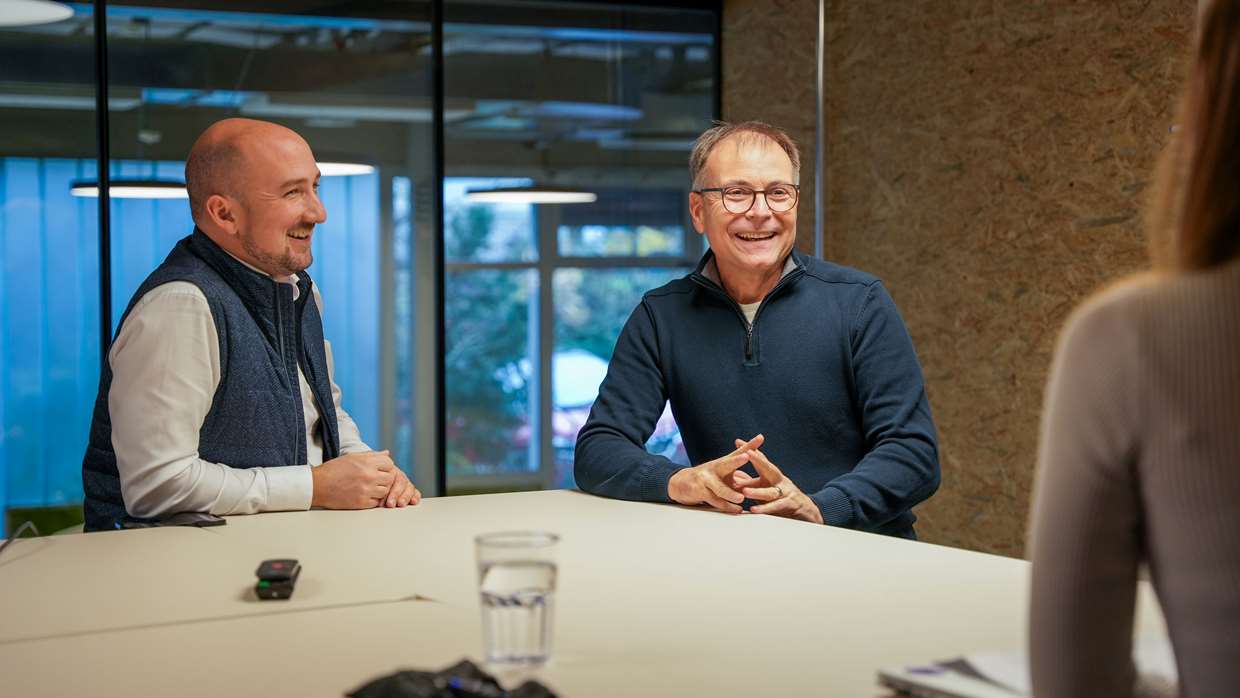
The management handover in Indirect Procurement at Galenica shows what this looks like in practice. Ulrich Witschi (59) built up the division and managed it for over 20 years. He decided early on to actively shape the change in management: “I wanted to give my team and Indirect Procurement a fresh impetus,” he says. He found his successor in Thibaut Chapron (35) – and opted for a smooth transition. Step by step, he transferred responsibility, passed on knowledge and gave the younger colleague room to make his own mark.
How to succeed in knowledge transfer and leadership change
Phased retirement opened up attractive prospects for Thibaut Chapron. Ulrich Witschi’s support made it easier for him to step into the leadership role. “I had time to familiarise myself and build up my expertise,” he says. After several years of successful collaboration, Thibaut Chapron took over as Head of Indirect Procurement on 1 July 2025. He can continue to count on Ulrich Witschi, who will remain part of the team as Deputy Head and Procurement Manager – and will also have the resources to transition into retirement.
The management duo communicated openly and closely involved the entire team in the generational change. Workshops and meetings strengthened trust and fostered dynamism. “The team is doing a very good job and has become even more independent,” adds Thibaut Chapron.
From boss to advisor
A successful phased retirement needs managers to be willing to rethink their own role: delegating responsibility, going through decisions together and taking on an advisory role. This requires courage and foresight – core values of servant leadership, i.e. leadership that focuses on serving the team. “I saw phased retirement as an added value for myself, my successor and Galenica,” emphasises Ulrich Witschi.

Three questions for Arianne Hasler, Chief People & Culture Officer, Member of the Executive Committee
As Chief People & Culture Officer, what do you think about Ulrich and Thibaut’s story?
It’s an impressive example of how servant leadership is practised at Galenica. Ulrich Witschi has actively shaped his phased retirement, focusing on the development of Thibaut Chapron and the success of the team.
What does it take to ensure successful long-term succession planning?
Early planning, open communication and a willingness to share expertise and relinquish responsibility are important. This builds trust within the team and among internal and external stakeholders. In addition, the chemistry between the two managers has to be right. The example of Ulrich Witschi and Thibaut Chapron shows the potential: combining experience and new approaches benefits employees, customers and Galenica.
Managers who step down from their prime leadership position and take up a secondary management role are usually over 55 years old. How important are employees of this generation at Galenica?
Galenica hired almost 100 employees over the age of 55 in 2025, both in pharmacies and in central functions. We believe that generational diversity can strengthen teams. Continuing to work beyond retirement age often offers opportunities for both parties. Experience and stability are qualities that we do not want to do without.